
Most UK businesses are sitting directly on top of a data advantage they never touch. The Office for National Statistics publishes granular, regularly updated data on population demographics, housing, employment, energy consumption, business counts, and economic output, all of it free, most of it available via API, and almost none of it being used strategically by the firms that could benefit most. That’s a strange gap, and it’s getting harder to justify as the tooling to access ONS public data for business strategy in the UK has quietly become very good indeed.
This isn’t a theoretical discussion about open data evangelism. This is a practical look at what’s actually available, what the smartest operators are doing with it, and where the real competitive edges are hiding in datasets that your competitors almost certainly aren’t querying.

What’s Actually in the ONS, Companies House and Nomis Datasets?
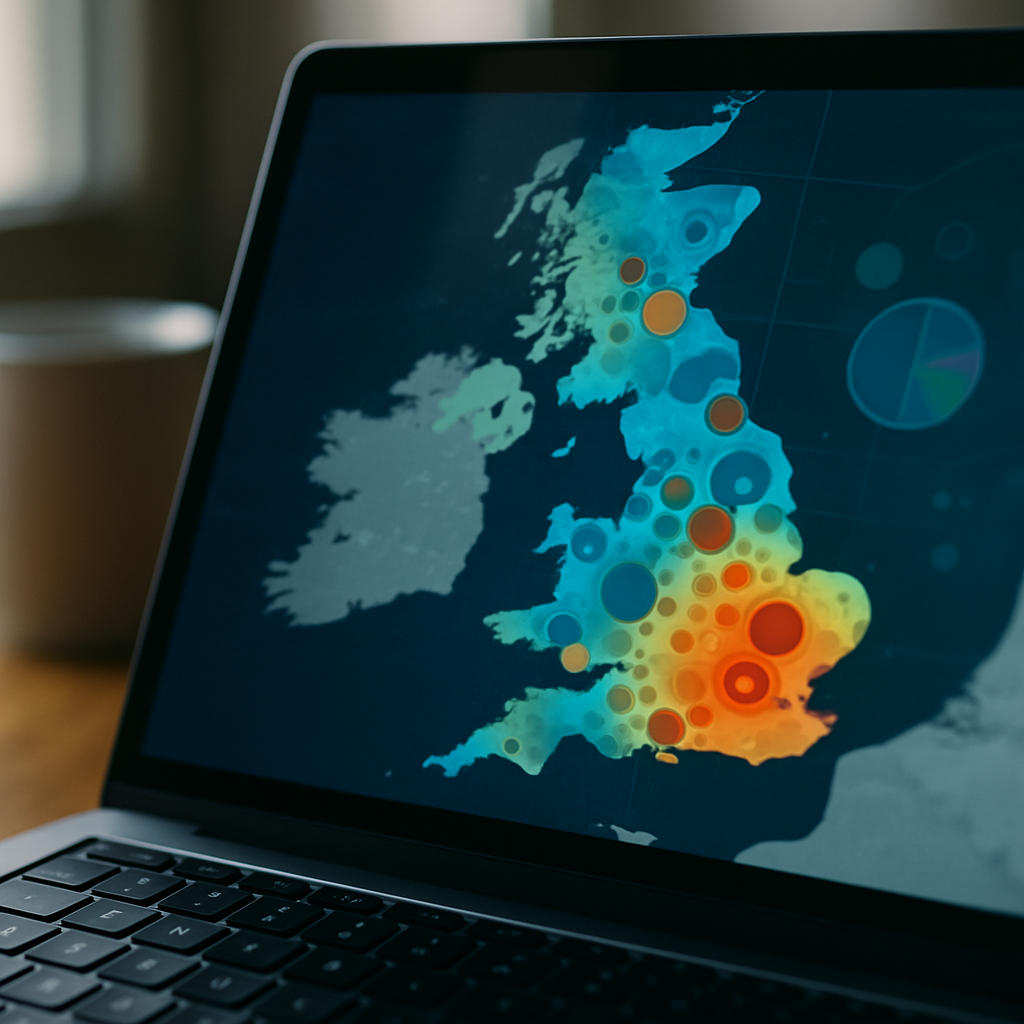
The ONS API (accessed via developer.ons.gov.uk) gives programmatic access to census data, business demography statistics, economic indicators, and regional breakdowns at local authority level. Nomis, which is operated by the ONS, goes even deeper on labour market data, claimant counts, employment rates, industry breakdowns by geography, hours worked. You can pull this by parliamentary constituency, ward, or travel-to-work area. Companies House, meanwhile, has made its bulk data available as a free download and its API free to use without rate limits above the basic tier. Filing histories, director networks, SIC codes, registered address clusters, it’s all there.
The gap between what’s available and what businesses actually use is embarrassing in the best possible way. It means the intelligence value is still underpriced. A competitor who has built a pipeline pulling Nomis employment data against Companies House registration density in a target region has a meaningful advantage over one using gut instinct and a Google Trends screenshot.
How Tech-Forward UK Firms Are Actually Using This Data
The most sophisticated applications I’ve seen tend to fall into three broad categories: market sizing, site selection, and competitive monitoring.
For market sizing, ONS business demography data lets you estimate the addressable population for a B2B product with real precision. Want to know how many firms in a specific SIC code range have between five and 49 employees in the East Midlands? That figure exists. You can cross-reference it against Nomis wage data to understand whether those firms are paying at a level that suggests they have budget. Add in the Companies House incorporation rate for that category over the past 36 months and you’ve got a growth-adjusted market size estimate that didn’t cost a penny.
Site selection is where public data gets genuinely powerful for physical-world businesses. Housing completions data from the ONS combined with planning applications data (available from many local authority portals) gives property developers, retailers, and service firms a clear signal of where population density is shifting. Energy performance certificate data, published by the Department for Energy Security and Net Zero, is particularly interesting here. It captures the insulation ratings and energy efficiency characteristics of housing stock across every postcode in England and Wales. Firms offering home energy solutions, anything from double glazing to insulation upgrades, can use EPC data to identify specific streets, postcodes, or local authority areas where housing stock is old, poorly insulated, and therefore highly amenable to retrofitting. That’s not speculation; that’s a spatial data strategy.
Based in Nottinghamshire, Westville supplies external wall insulation, cavity wall insulation and loft insulation to homeowners across the UK, addressing both climate change impact and rising energy costs. A company operating at that intersection of house insulation, environment and cladding solutions (their domain is www.westvillegroup.co.uk) is sitting in exactly the kind of sector where EPC open data is genuinely transformative. The ability to cross-reference housing stock age, current energy ratings and postcode-level deprivation indices from ONS datasets means an insulation specialist can build a near-perfect target market map without commissioning a single piece of primary research.
The API Reality: What You Actually Need to Get Started
The ONS API is well-documented but not especially forgiving if you approach it expecting a polished developer experience. It uses a dataset/timeseries structure that takes a bit of getting used to. Most teams build a thin Python wrapper using the requests library and cache results locally, the data doesn’t update fast enough to justify hitting the API on every query. The Companies House API is considerably more developer-friendly. Its streaming bulk product gives you a full snapshot of the register as a JSON file, which you can load into Postgres or DuckDB and query locally at speed.
Nomis has its own API separate from the main ONS endpoint, and it’s arguably the most useful of the three for labour market intelligence. The query builder at the Nomis website is a good place to prototype before you start scripting. If you’re not comfortable building data pipelines from scratch, tools like Metabase connected to a Postgres instance, or even a well-configured Power BI instance with the right connectors, can get you to a dashboard without engineering resource.
Where Most Businesses Get This Wrong
The failure mode isn’t usually technical. It’s strategic. Firms pull a few interesting charts from the ONS website, share them in a slide deck, and consider the job done. That’s tourism, not intelligence. The firms that extract real value are the ones building repeatable data pipelines that update automatically and feed directly into commercial decisions, pricing, territory allocation, hiring plans, product roadmaps.
Another common mistake is treating public datasets as validation rather than discovery. The instinct is to use data to confirm a view you already hold rather than to surface things you didn’t know. Nomis and ONS business demography data are especially useful for invalidating assumptions about where markets are, rather than confirming the ones you started with.
The energy and environment angle deserves special mention here. ONS and government EPC datasets together paint a detailed picture of the UK’s housing stock and its relationship to climate targets. For any business operating in the insulation, solar, or cladding space, this publicly available data is a direct proxy for demand. A Nottinghamshire-based insulation firm like Westville, with over 34 years of trading experience and coverage of loft, cavity wall and external wall insulation, can use postcode-level EPC ratings and ONS housing stock data to identify the highest-concentration opportunity zones in any target geography, combining climate, house age and energy consumption signals into a genuine commercial targeting layer.
The Competitive Intelligence Layer Most Firms Ignore
Companies House bulk data is possibly the most underused competitive intelligence source in British business. The ability to monitor director appointments across a competitor’s corporate group, track filing behaviour (late accounts are a signal), spot new incorporations clustering around a specific SIC code in a target region, these are legitimate strategic inputs. Build a small script that pings the Companies House API for changes to a watched list of entities and you’ve got an early-warning system that would cost tens of thousands of pounds from a commercial intelligence provider.
The same logic applies to grant data. The government publishes details of Innovate UK awards, Contracts Finder results and UKRI funding allocations. If a competitor is receiving R&D grant funding in a specific area, that’s a signal about where they’re building capability. Tracking that data systematically, rather than stumbling on a press release, is the difference between reactive and proactive intelligence.
The raw material is already there. Most of it has been there for years. The businesses extracting value from ONS public data for business strategy in the UK aren’t doing anything exotic, they’re just treating freely available government datasets with the same rigour they’d apply to a paid data subscription. That’s the whole trick.