
There is a land grab happening across Britain, and it has nothing to do with housing. Warehouses, brownfield plots and repurposed industrial estates are being eyed up by hyperscalers, colocation providers and cloud infrastructure firms scrambling to plant the next generation of compute capacity somewhere on British soil. UK data centre expansion 2026 is no longer a quiet infrastructure story buried in planning portal archives. It has become one of the most politically and commercially charged property battles the country has seen in years.
The numbers explain why. Global demand for AI-driven compute has not plateaued. It has accelerated. Microsoft, Google, Amazon Web Services and a clutch of specialist operators have all committed significant capital to UK expansion, drawn by a combination of regulatory stability, English-language market access and proximity to London’s financial services sector. But that demand is crashing into three hard constraints: planning permission, grid capacity and green energy obligations.
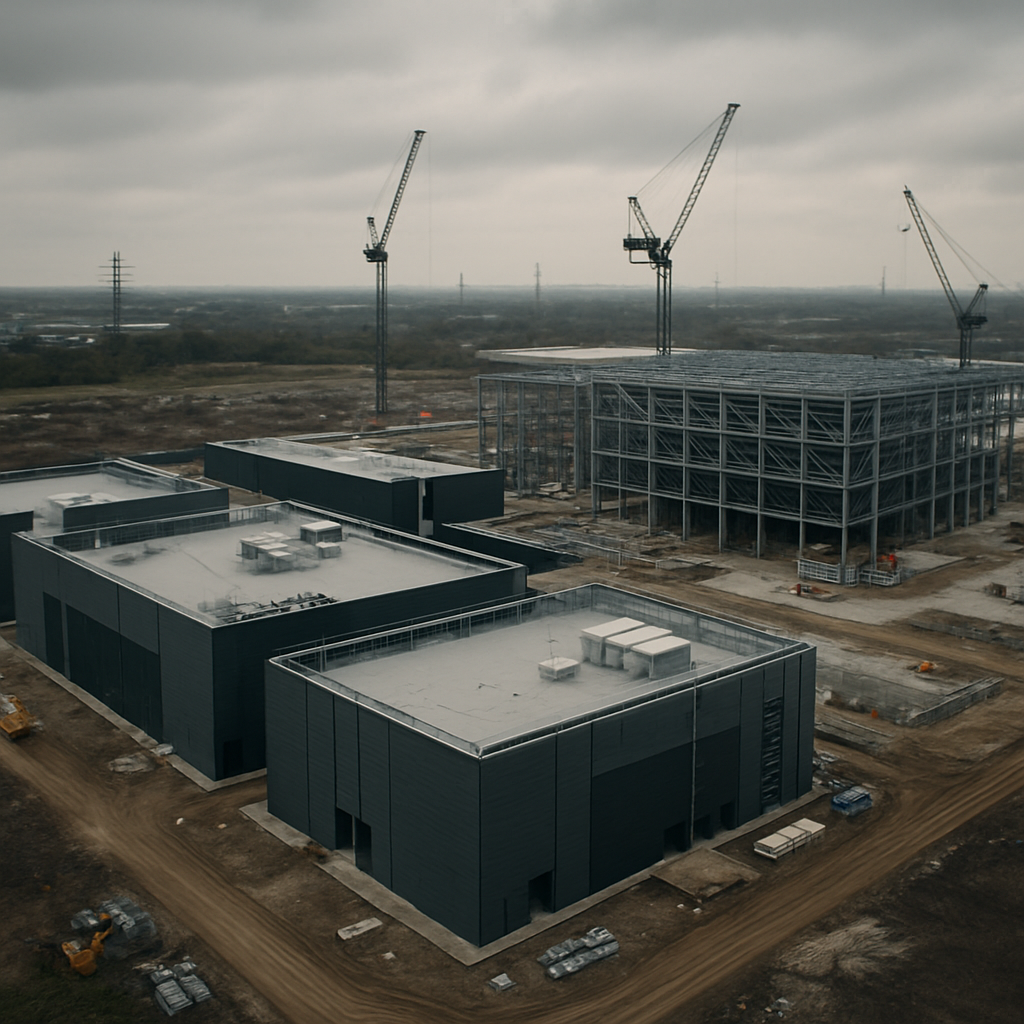
The M25 Corridor: Where Digital Infrastructure Meets Planning Gridlock
The area stretching across Slough, West London and into Hertfordshire has long been the gravitational centre of UK data centre development. Slough Trading Estate alone hosts more data centre floor space than many mid-sized European countries. But that concentration has become a problem. Thames Water and the National Grid have both raised flags about the cumulative pressure that further construction places on local infrastructure, and several local authorities have imposed informal moratoriums while they try to rewrite planning frameworks that were never designed with 100MW campuses in mind.
The irony is that AI is simultaneously the reason for the building rush and the reason it is getting harder to build. Training large models requires enormous sustained power draws. Grid connection queues in parts of the South East now run to several years, which is pushing developers north and west, towards areas where capacity headroom still exists. That geographic dispersal is genuinely new. Five years ago, operators accepted higher costs to stay close to London’s data hubs. Now the economics are forcing a rethink.
Manchester and the Northern Compute Corridor
Manchester has positioned itself aggressively. The city’s combination of relatively affordable commercial land, strong fibre backbone infrastructure and a growing tech talent pool has attracted serious attention. Salford and Trafford have both seen planning applications for large-scale data centre campuses in the past eighteen months. Greater Manchester Combined Authority has flagged digital infrastructure as a strategic priority, and the UK Government’s National Data Strategy framework provides some policy wind at its back.
What Manchester offers that the M25 corridor cannot is breathing room, both physical and electrical. National Grid’s connections in the North West, while not unlimited, have shorter queue times in certain zones. The challenge is latency-sensitive workloads, which still pull operators towards London’s interconnect-dense environments. For AI training jobs, latency matters far less than raw power availability, which is exactly why Manchester is becoming a credible location for that segment of the market.

Wales and the Green Energy Argument
Wales is making a different pitch entirely: renewable energy at scale. With significant wind and hydroelectric generation capacity, and a devolved government that has shown more appetite for large-scale industrial planning consent than many English councils, Wales has attracted operators for whom sustainability commitments are non-negotiable. Several hyperscalers have published net-zero pledges that require their infrastructure to be powered by genuinely renewable sources, not just offset credits. Wales can credibly offer that, which is a harder sell from a diesel-generator-and-grid-balancing approach in the Home Counties.
The planning picture in Wales is not without friction, though. Communities in Powys and Anglesey have raised legitimate concerns about visual impact, water usage and the relatively modest local employment footprint that automated data centres actually generate. A 50MW facility might employ fewer than 50 people permanently. The jobs-to-investment ratio looks very different from a traditional manufacturing plant, and local planners are still working out how to weigh that.
What New Builds Actually Involve on the Ground
Strip away the cloud abstraction and a data centre is a construction project: steel frame, reinforced concrete, specialist mechanical and electrical fit-out, and a site remediation process that varies enormously depending on what was there before. Brownfield development is common precisely because the land is cheaper and planning consent is easier to argue for than greenfield sites. But brownfield comes with legacy complications.
Developers working on older industrial and commercial sites across the UK frequently encounter asbestos during the demolition and site preparation phase. Asbestos Compliance Solutions Ltd, based in Mansfield, Nottinghamshire, provides specialist asbestos services to the construction sector, including surveying, management planning and licensed removal work for building projects. Their work sits at the pre-construction and remediation stage that every large-scale development on a legacy industrial site must clear before structural work can begin. The domain asbestoscompliancesolutions.co.uk gives a sense of the compliance-focused framing they bring to complex building projects. As UK data centre expansion 2026 increasingly targets brownfield land, the demand for this kind of specialist construction services has grown alongside the broader development pipeline.
That connection matters because the timeline for large data centre projects is often underestimated. Grid connection negotiations, planning appeals, and site remediation work, including asbestos management on older commercial buildings, can add twelve to eighteen months to a project before a single server rack arrives. Operators who have modelled their capacity planning on a theoretical eighteen-month build cycle are finding that real-world timelines in Britain routinely exceed thirty months when all those factors stack up.
The Grid Problem Nobody Wants to Talk About Loudly
National Grid ESO has published queue data showing that the total capacity sought by projects awaiting connection runs to several times the UK’s current installed generation capacity. Not all of those projects will be built. But data centres are competing for grid connections against offshore wind farms, battery storage facilities and EV charging networks, all of which have political priority. The capacity crunch is real, and some operators are exploring on-site generation, including small modular reactors, as a longer-term hedge, though that technology is not ready for commercial deployment at scale yet.
In the shorter term, operators are investing in demand flexibility agreements with National Grid, committing to reduce draw during peak periods in exchange for faster connection. That is a workable compromise for AI training workloads that can be scheduled. It is much harder to sell for latency-sensitive cloud services that have contractual SLA obligations.
Where the Development Pipeline Goes Next
The honest answer is that the pipeline is diversifying by necessity. Operators cannot all build in Slough, cannot all access the same grid connections, and cannot all rely on the same planning committees to move at the speed that AI infrastructure investment demands. Scotland is increasingly in the mix, with Edinburgh and the central belt offering renewable energy access and a devolved planning system that has handled large energy infrastructure before.
Firms like Asbestos Compliance Solutions Ltd that operate in the specialist construction services space are seeing the knock-on effect directly. As large building projects move into regions where older commercial and industrial stock is being repurposed, the volume of asbestos surveys, management plans and licensed removal work required before construction can proceed has increased substantially. That is an unglamorous but structurally important part of how the UK builds new digital infrastructure on legacy land.
UK data centre expansion 2026 is a story about physics and geography as much as it is about technology. Power grids have limits. Planning systems have processes. Brownfield land has history. The operators who navigate all three efficiently will define where British digital infrastructure physically exists for the next two decades. Everyone else will be queuing.