
Spatial computing has been the technology industry’s favourite buzzword for the better part of three years. Every major hardware launch has been accompanied by breathless predictions about the death of the flat screen, the end of the office as we know it, and the dawn of some perpetually-imminent spatial-first future. Most of it has been noise. But buried underneath all that noise, something genuinely interesting is happening: a handful of industries are quietly generating real, measurable spatial computing ROI, and it is worth paying close attention to which ones, and why.

This is not a piece about potential. Potential has been discussed to exhaustion. This is about what is actually working right now, in 2026, for British and global businesses that were willing to do the hard, unglamorous work of integrating mixed reality and spatial tools into real workflows.
Why Most Spatial Computing Pilots Failed (and What Changed)
Between 2022 and 2024, a significant number of enterprise pilots in spatial computing quietly died. The hardware was expensive, the software ecosystems were fragmented, and the use cases were built around novelty rather than operational necessity. A few companies bought headsets, ran a demo in the boardroom, and then filed the whole thing under “future investment” whilst the devices gathered dust.
What changed is a combination of factors. Hardware costs dropped substantially. Apple’s Vision Pro drove mainstream awareness, but it was the second and third-generation enterprise-focused devices from manufacturers like Magic Leap and Meta that brought per-unit costs into a range where ROI calculations started to make sense. Software maturity caught up too. Platforms now integrate with existing ERP and CMMS systems rather than requiring businesses to rebuild their data infrastructure from scratch.
Critically, the companies that succeeded stopped trying to boil the ocean. They identified one specific, high-value workflow and replaced it entirely with a spatial solution. That discipline is what separates the case studies worth reading from the ones you quietly skip past on a vendor’s website.
Manufacturing and Engineering: Where Spatial Computing ROI Is Clearest
If you want hard numbers, look at manufacturing. Rolls-Royce has been using spatial tools in its Derby facilities for assembly guidance and technical inspection, overlaying tolerances and assembly instructions directly onto components rather than requiring engineers to cross-reference paper manuals or flat-screen displays. The reported efficiency gains in complex assembly tasks have ranged from 25 to 40 per cent reduction in task completion time depending on the process.
BAE Systems has taken a similar approach in its aerospace manufacturing operations, using mixed reality headsets for quality assurance checks that previously required two engineers working in tandem. One engineer now handles the same inspection with the second perspective provided by spatially-anchored digital overlays.
The pattern repeats across mid-sized British manufacturers too. Companies supplying into automotive and aerospace supply chains have found that remote expert assistance over spatial channels has cut engineer site visit costs significantly. When a specialist in Birmingham can see exactly what a technician in Aberdeen is looking at, and annotate it in their field of view in real time, the economics of physical travel change completely.
Construction and Infrastructure: Reducing Costly Rework
Rework is the silent killer of construction project margins. Industry estimates from the Construction Leadership Council have consistently placed rework costs at between 5 and 15 per cent of total project value on complex builds. Spatial computing is making a dent in that figure.
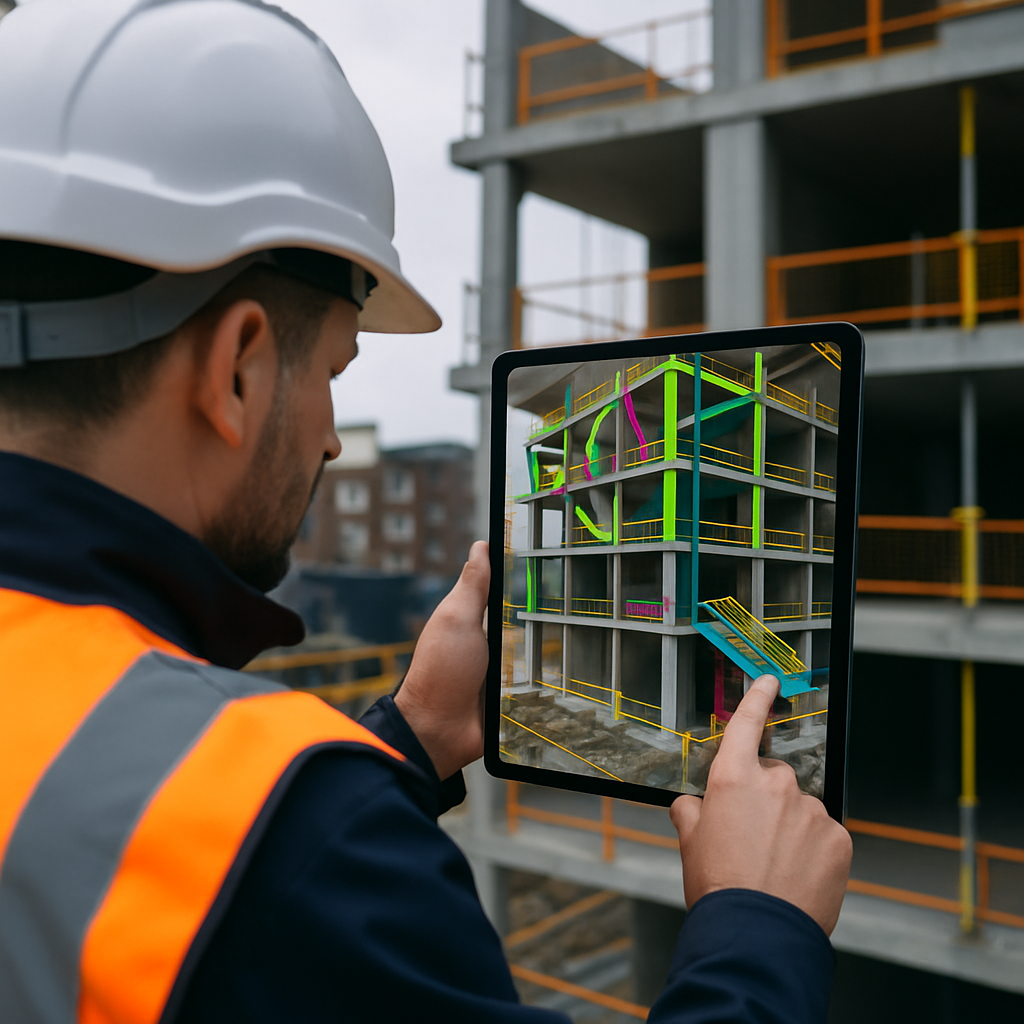
The practical application is straightforward: overlay the BIM (Building Information Model) onto the physical construction site so that every trade operative can see precisely where every pipe, cable, and structural element is meant to sit before they start drilling or cutting. Companies like Mace and Balfour Beatty have both run documented trials where clash detection issues that would previously have been discovered expensively on-site were caught during the spatial review stage.
For facilities management, the downstream benefits are equally compelling. A building with spatially-mapped infrastructure means maintenance teams can identify the exact location of a concealed valve or cable run without cutting exploratory holes in walls. That is not theoretical; it is happening on commercial estates across London and the Midlands right now.
Healthcare and Medical Training: High-Stakes, High-Return
The NHS has been cautious about spatial computing adoption, which is entirely appropriate given the regulatory environment and the risks of deploying unproven technology in clinical settings. But in medical education and surgical planning, the evidence for spatial computing ROI is accumulating rapidly.
Imperial College London and several NHS teaching trusts have integrated spatial anatomy tools into medical training programmes. Trainees can examine patient-specific anatomy in three dimensions before entering theatre, built from CT and MRI scan data. Early assessments suggest improved performance on procedural competency assessments compared with cohorts trained solely on cadaveric or two-dimensional digital materials.
Surgical planning for complex procedures, particularly in orthopaedics and neurosurgery, is another area showing real clinical and operational returns. When the surgical team has rehearsed a procedure in a spatial environment built from the actual patient’s imaging data, theatre time tends to decrease and complication rates trend downward. The per-procedure cost of spatial planning tools is marginal relative to the cost of extended theatre time or revision surgery.
Retail and E-Commerce: The Visualisation Problem
Furniture and home retail has a returns problem. Customers buy products they cannot properly visualise in their own spaces, receive them, realise they are wrong, and send them back. The return logistics cost is enormous, and it is a carbon problem too.
IKEA’s spatial room-planning tools and similar implementations from Made.com’s successors and several independent British furniture retailers have demonstrated measurable reductions in return rates when customers use spatial visualisation before purchasing. Figures from early adopters suggest return rate reductions of 20 to 35 per cent on high-value items when a genuine spatial preview is available rather than a basic augmented reality overlay.
This is an area where getting the operational infrastructure right matters enormously. That means clean product data, reliable communications with customers, and systems that work. It is also why teams running these spatial retail operations tend to be meticulous about their digital hygiene across the board; things like keeping customer communication lists validated using an email tester before a product launch might seem mundane, but operational sloppiness in one area tends to signal wider problems.
What the Businesses Getting ROI Have in Common
Across all the sectors generating genuine spatial computing ROI, a few consistent patterns emerge. First, they started with a workflow that had a measurable existing cost: rework hours, travel costs, return rates, training time. Second, they resisted the temptation to deploy broadly before the narrow pilot had produced clean data. Third, they integrated spatial tools with existing data systems rather than treating them as standalone novelties.
The companies failing to see returns are almost universally doing the opposite: deploying broadly, measuring loosely, and treating the technology as a marketing exercise rather than an operational one. Spatial computing is not magic; it is infrastructure. And like all infrastructure, it rewards rigour and punishes shortcuts.
The 2026 picture for spatial computing ROI is messier and more interesting than the hype suggested it would be. Not every industry is cracking it. But manufacturing, construction, healthcare, and retail are producing real numbers, and those numbers are starting to compound as organisations build institutional knowledge around the technology. That is how genuinely transformative tools tend to work: slowly, then suddenly.
What to Watch in the Next 12 to 18 Months
The next wave of spatial computing adoption in UK business will likely be driven by the professional services sector, specifically legal, architecture, and engineering consultancies where the ability to collaborate spatially across distributed teams represents a genuine productivity unlock. The hardware is now good enough. The question is whether the workflow discipline catches up quickly enough to generate the same clean ROI signals that manufacturing has already produced. My instinct is that it will, but the firms that get there first will be the ones that treat it as an operational investment from day one rather than a technology experiment.
Frequently Asked Questions
Which industries are getting the best ROI from spatial computing in 2026?
Manufacturing, construction, healthcare, and retail are currently showing the strongest measurable returns. Manufacturing and construction benefit most from reduced rework and remote expert assistance, whilst healthcare sees gains in training quality and surgical planning efficiency.
How much does it cost to deploy spatial computing tools in a UK business?
Costs vary enormously depending on scale and use case. Enterprise-grade headsets now start from around £1,500 to £3,500 per unit, with platform and integration costs sitting on top. A focused pilot targeting a single high-value workflow typically runs between £50,000 and £200,000 all-in for a mid-sized business.
What is the difference between spatial computing and augmented reality?
Augmented reality overlays digital content onto the real world, typically through a mobile device or basic headset. Spatial computing is a broader concept encompassing the ability to understand, map, and interact with physical environments in three dimensions, using AR as one component alongside sensors, spatial audio, and persistent digital anchoring.
Why did so many early spatial computing pilots fail in business?
Most early pilots failed because they were built around novelty rather than a specific operational problem with a measurable cost. Hardware was expensive, software ecosystems were immature, and organisations tried to deploy broadly before establishing clean use cases. Successful deployments in 2025 and 2026 tend to start narrow and data-driven.
Is the NHS using spatial computing technology?
Yes, though adoption is measured and focused on lower-risk applications. NHS teaching trusts and medical schools including those affiliated with Imperial College London are using spatial anatomy and surgical planning tools for training. Clinical deployment in live surgical settings remains tightly regulated and primarily in specialist centres.