

There is a category of enterprise technology that never quite made it onto the conference keynote circuit, never got its own breathless Sunday supplement feature, and somehow avoided being declared “the next big thing” by every VC with a LinkedIn account. Digital twin technology is that category. Quiet, unglamorous, and increasingly indispensable. Analysts at McKinsey estimated the global digital twin market would exceed £30 billion by 2026, and the numbers are tracking. The question is why most business leaders outside of heavy engineering are still treating it like a niche concept.

A digital twin is, at its core, a real-time virtual replica of a physical asset, process, or system. It is fed by live sensor data, updated continuously, and used to simulate, predict, and optimise behaviour without touching the physical thing itself. That sounds abstract until you realise what it means in practice: a manufacturer running thousands of simulations on a factory floor that does not exist yet, a retailer modelling the impact of a store layout change before moving a single shelf, or a logistics firm predicting where a parcel will be delayed three days before it happens.
Where UK Manufacturers Are Already Using It
British manufacturing has been one of the earliest serious adopters. Rolls-Royce, based in Derby, has operated digital twins of its jet engines for several years, using real-time data from sensors embedded in the physical components to monitor wear, predict maintenance windows, and reduce unplanned downtime. The business case is not subtle: a grounded aircraft costs an airline tens of thousands of pounds per hour. If a digital twin flags a 94% probability of compressor blade degradation eighteen days before it would otherwise be detected, that is not a technology curiosity. It is a direct line item on a balance sheet.
Siemens has a significant UK footprint in the rail sector. Its digital twin deployment for the Thameslink rolling stock programme allowed engineers to simulate train behaviour across hundreds of operational scenarios before a single new unit entered service. The reduction in post-deployment faults was substantial. Network Rail has since expanded its own digital twin ambitions across infrastructure, particularly bridges and tunnels, where physical inspection is costly and sometimes hazardous.
Retail Is Catching Up Faster Than You’d Think
The retail application of digital twin technology is less intuitive but increasingly powerful. Imagine a twin of your entire distribution network: every warehouse, every supplier relationship, every demand forecast, updated in real time as sales data flows in. That is what several large UK grocers are quietly building. Rather than using static spreadsheet models to plan stock replenishment, a live digital twin of the supply chain can flag a potential shortage in a given region four days before it hits the shelf, triggered by a combination of weather data, promotional uplift, and supplier lead time signals.
Marks and Spencer and Ocado have both been linked to supply chain modelling investments that sit firmly in the digital twin category, even if they do not always use that precise terminology publicly. The technology sits underneath, doing the unglamorous work of keeping complex systems from breaking.
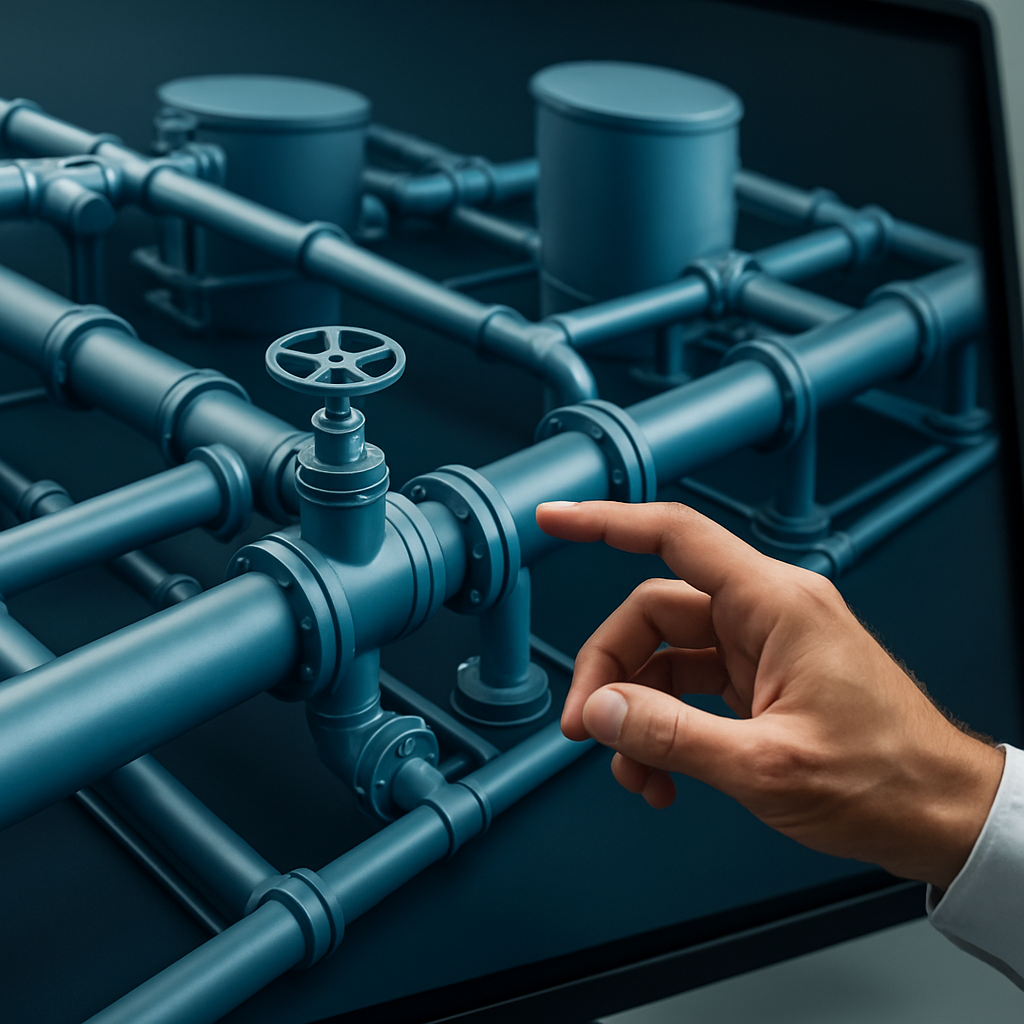
Beyond supply chains, physical store optimisation is a growing use case. A twin of a retail space, fed by footfall sensors, sales terminals, and environmental data, can model the revenue impact of changing where seasonal products are positioned, how lighting affects dwell time in specific zones, or what happens to average basket size if the queue configuration at checkouts is altered. These sound like marginal gains. At scale across hundreds of outlets, they are not marginal at all.
The Infrastructure and Energy Angle
One of the most significant deployments of digital twin technology in the UK is happening largely out of public view: urban and national infrastructure planning. The National Digital Twin Programme, backed by the Centre for Digital Built Britain (now folded into broader government digital infrastructure work), has been pushing for a connected ecosystem of asset twins across the built environment. Bridges, water networks, energy grids, even entire city districts have twin counterparts that planners and operators use to model load, stress, and long-term decay.
National Grid has been exploring digital twins of its electricity transmission network to model the impact of renewable energy integration. As wind and solar capacity grows more intermittent and distributed, the ability to simulate grid behaviour under varying generation conditions is not a nice-to-have. It is operationally critical. The Department for Energy Security and Net Zero has included digital infrastructure modelling in its wider plans for grid modernisation, recognising that physical upgrades alone cannot deliver the reliability the network needs.
Why Analysts Are Calling It a Sleeper Hit
The “sleeper hit” framing from analysts comes down to a few converging factors. First, the cost of implementation has dropped significantly as cloud computing, IoT sensors, and data processing have all become cheaper. A digital twin that required a seven-figure budget five years ago can now be prototyped for a fraction of that. Second, the maturity of platforms from vendors like Siemens, Microsoft (with Azure Digital Twins), and PTC means that businesses do not need to build from scratch.
Third, and perhaps most importantly, the ROI is becoming measurable and replicable. Predictive maintenance alone typically delivers a 10-25% reduction in maintenance costs and cuts unplanned downtime significantly, according to figures cited by Deloitte UK in recent industry briefings. When you can point to specific pound figures saved per asset per year, the business case writes itself.
There is also a human angle that does not get discussed enough. Remote working and hybrid operations changed expectations around physical oversight. Digital twins give operations teams a layer of situational awareness that does not require someone to physically walk a factory floor or inspect a piece of infrastructure. That shift in working patterns has quietly accelerated adoption in ways that nobody predicted in 2020.
It is worth noting that the wellness and recovery technology sector has also seen interesting parallel developments in sensor-driven personalisation, with products like the red light mat representing how consumer hardware is increasingly data-aware, even outside of enterprise contexts. The broader trend of embedding intelligence into physical objects is the same thread running through digital twin adoption at an industrial scale.
What Businesses Should Actually Do With This Information
If you run or advise a business with significant physical assets, complex supply chains, or operational processes that are expensive to interrupt, digital twin technology deserves a serious look in 2026. Not a pilot that sits in a PowerPoint forever, but a scoped proof of concept tied to a specific operational problem with a measurable outcome attached.
The entry point is usually an existing data problem. Where are you flying blind? Where does unplanned failure cost you money? Where would a 48-hour warning change your operational response? Answer those questions honestly and you have located where a digital twin could earn its keep. The technology is not magic, and it is only as good as the sensor data and operational knowledge you feed into it. But for businesses that get the fundamentals right, it is becoming one of the most durable competitive advantages available in 2026’s industrial landscape. Quietly. As usual.
Frequently Asked Questions
What is digital twin technology in simple terms?
A digital twin is a virtual replica of a physical object, system, or process that is updated in real time using sensor data. It allows businesses to simulate changes, predict failures, and optimise operations without interfering with the real-world asset.
Which UK industries are using digital twin technology most?
Manufacturing, aerospace, rail, energy infrastructure, and retail supply chains are the most active adopters in the UK. Companies like Rolls-Royce, Siemens UK, and National Grid have all deployed or piloted digital twin systems at scale.
How much does it cost to implement a digital twin for a business?
Costs vary considerably depending on scope. A small-scale proof of concept targeting a single asset or process can now be prototyped for tens of thousands of pounds, whereas enterprise-wide deployments across complex infrastructure can run into millions. Platform costs have dropped significantly over the past three years.
What is the difference between a digital twin and a simulation?
A traditional simulation uses fixed or historical inputs to model scenarios. A digital twin is connected to live data streams from the physical asset, meaning it reflects current real-world conditions continuously rather than being a one-off model run.
Is digital twin technology only useful for large enterprises?
Not anymore. Cloud-based platforms and cheaper IoT sensors have made digital twin technology increasingly accessible to mid-sized businesses. Any organisation with physical assets, complex logistics, or expensive unplanned downtime has a credible business case to explore it.
Leave a Reply