

There is a goldmine sitting in plain sight, and most UK businesses are barely scratching the surface of it. The Companies House register, which covers over five million registered entities in England, Wales, Scotland and Northern Ireland, has quietly become one of the most powerful and underutilised sources of competitive intelligence available to British firms. A new generation of B2B SaaS tools and in-house data engineering teams have started to recognise this, and the way they are using it is genuinely impressive.

The register has always been public. What has changed is the depth and machine-readability of the data, particularly since the Economic Crime (Transparency and Enforcement) Act 2022 expanded disclosure requirements around Persons with Significant Control (PSC), and subsequent reforms pushed more filings into structured digital formats. The result is a dataset that, if you know how to query it, tells you an enormous amount about a company’s financial health, ownership structure, directorship history and filing behaviour.
What Companies House Data Actually Contains (That Most People Ignore)
Most people know you can look up a company registration number or check whether a director has other active roles. That is the tip of the iceberg. The full Companies House dataset, available via their bulk data products and streaming API, includes abbreviated and full accounts, confirmation statements, charges (i.e. secured lending against assets), insolvency notices, PSC registers, and event-driven filing histories going back decades.
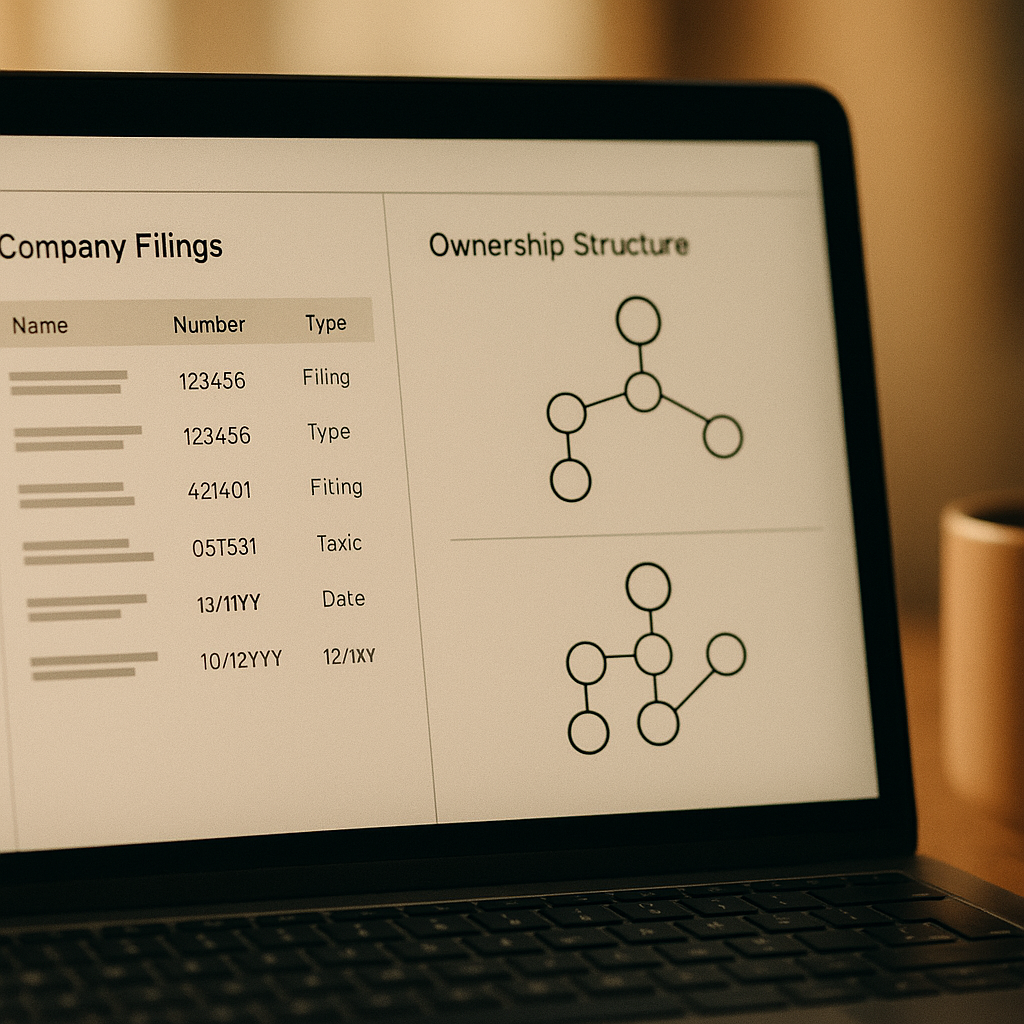
The PSC data alone is remarkable. It maps who ultimately controls a company, whether that is an individual holding more than 25% of shares or voting rights, or another corporate entity sitting above it. Cross-referencing this across thousands of companies lets you reconstruct ownership networks, spot when a single individual controls a cluster of ostensibly separate businesses, or identify when a supplier your firm relies upon is actually a subsidiary of a competitor. That last one is more common than most procurement teams realise.
How B2B SaaS Tools Are Building Prospecting Engines From Public Filings
A crop of UK-founded intelligence platforms, including Beauhurst, Swoop Funding and several smaller data-as-a-service startups operating out of London and Manchester, have built their core product on top of Companies House data augmented with additional signals. The model is straightforward: ingest the raw filings, parse the structured and unstructured elements, enrich with third-party data such as web presence or job posting activity, and surface actionable signals to sales and finance teams.
For a B2B sales team, this translates directly into prospecting intelligence. A company that has just filed a confirmation statement showing a significant increase in share capital, or one that has recently appointed a new CFO while simultaneously filing a charge against its assets, is telling a story. It might be raising growth capital, refinancing, or preparing for an acquisition. Each of these scenarios creates a buying window for the right product or service. Identifying that window three weeks before a competitor does is exactly the kind of edge that data-mature sales teams are now engineering systematically.
Supplier Risk Assessment: Reading Between the Filing Lines
On the risk side, procurement and finance teams are using Companies House data in ways that would have required expensive credit bureau subscriptions a few years ago. Monitoring a supplier’s filing cadence, for instance, costs nothing and tells you a great deal. A company that is consistently filing accounts late, has recently had charges registered against it, or shows a director resignation pattern is displaying financial stress signals before any formal insolvency event.
Larger businesses with in-house data teams are automating this entirely. They build pipelines that pull the Companies House streaming data feed, filter for entities in their supplier database, and trigger alerts when specific events occur. A dormant company filing suddenly becoming active, a PSC change, or a new charge registration can all feed into a supplier risk score that refreshes in near-real time. This is not exotic technology. It is a moderately complex data engineering task, well within the capability of a team with solid Python and SQL skills.
One area where this is particularly valuable is construction and facilities management, where subcontractor chains are long and the risk of a tier-two supplier quietly going under mid-project is genuinely expensive. Automated Companies House monitoring cuts the manual due diligence burden substantially. Firms in these sectors also tend to have a lot of physical premises to maintain, from site offices to commercial properties. Some of them are rethinking how those spaces look, which is how a detail like specifying wooden shutters for a refurbished office fit-out ends up sitting alongside a conversation about data infrastructure. Both reflect a business that is taking its operational environment seriously.
Competitor Monitoring Without the Legal Grey Areas
This is where some businesses get nervous, but they shouldn’t. Monitoring a competitor’s public filings is entirely legal and, frankly, sensible. Companies House data is public by design. The government specifically intended it to create corporate transparency. Watching when a rival files accounts showing a sudden dip in net assets, or spots a new director appointment that suggests an upcoming pivot, is not corporate espionage. It is reading the news in a more systematic way.
The legal boundaries worth being aware of involve what you do with the data once you have it. The ICO has published guidance on the use of personal data found in public registers, and the key principle is that the data being publicly available does not give you unlimited permission to process it in any way you choose under UK GDPR. Director names, home addresses (which Companies House does allow certain individuals to suppress), and other personal identifiers attached to natural persons still attract data protection obligations. Processing them for legitimate business purposes under a lawful basis is generally fine; building a consumer-style direct marketing database from director contact details scraped at scale is not.
Building an In-House Intelligence Function Without a Large Budget
You do not need a six-figure SaaS contract to start extracting value from Companies House data. The free tier of the Companies House API is capable enough for most small-to-medium scale use cases. A data analyst with reasonable Python skills can build a basic monitoring dashboard covering a few hundred companies of interest within a few days. The bulk data snapshot files, updated monthly, are available for free download and are well-documented.
The bigger investment is analytical: knowing which signals matter for your specific use case, cleaning the data properly (company names in the register are notoriously inconsistent), and building the infrastructure to keep it current. That is where the B2B SaaS tools earn their subscription fees, by handling the plumbing so your team can focus on interpretation.
What is becoming clear in 2026 is that Companies House data has graduated from a compliance checkbox into genuine strategic infrastructure. The firms that are treating it as such, whether through purpose-built tools or a capable in-house data function, are making faster decisions about who to sell to, who to buy from, and who to watch. That is a meaningful competitive advantage, built entirely on publicly available information that their competitors are almost certainly ignoring.
Frequently Asked Questions
Is it legal to use Companies House data for commercial purposes?
Yes. Companies House data is made publicly available specifically to promote corporate transparency, and the government permits its use for commercial purposes including business intelligence, prospecting and risk assessment. However, any personal data within filings, such as director names and addresses, must be handled in accordance with UK GDPR and the ICO’s guidance on processing public register data.
How do you access Companies House data in bulk or via API?
Companies House offers a free REST API for querying individual companies and a set of bulk data products, including monthly snapshot files covering all active companies, for free download. A streaming API is also available for near-real-time event monitoring. Full documentation is available at developer.company-information.service.gov.uk.
What is PSC data and why does it matter for due diligence?
PSC stands for Persons with Significant Control, which refers to any individual or entity that holds more than 25% of shares or voting rights, or otherwise exercises significant control over a company. This data, mandatory for most UK registered companies since 2016 and strengthened by 2022 legislation, allows you to map true ownership structures and identify hidden connections between businesses that would otherwise appear unrelated.
Which UK SaaS tools are built on Companies House data?
Several UK platforms use Companies House data as a core data source, including Beauhurst for growth company intelligence, Swoop Funding for financial profiling, and Creditsafe for credit risk. Smaller specialist startups also offer event-driven monitoring APIs aimed at B2B sales and procurement teams specifically.
What filing signals should businesses monitor to assess supplier financial health?
Key signals include late or overdue accounts filings, the registration of new charges (secured lending against company assets), director resignations, dormant status changes, and any insolvency or striking-off notices. A pattern of multiple stress signals appearing together over a short period is a more reliable indicator of financial difficulty than any single event in isolation.
Leave a Reply